Most-cited age range
Ages 6 to 8
Cello also welcomes late-starting teens and adults — it is one of the most popular instruments for adult beginners because the seated posture is comfortable and the tone is forgiving.
Cello readiness guide
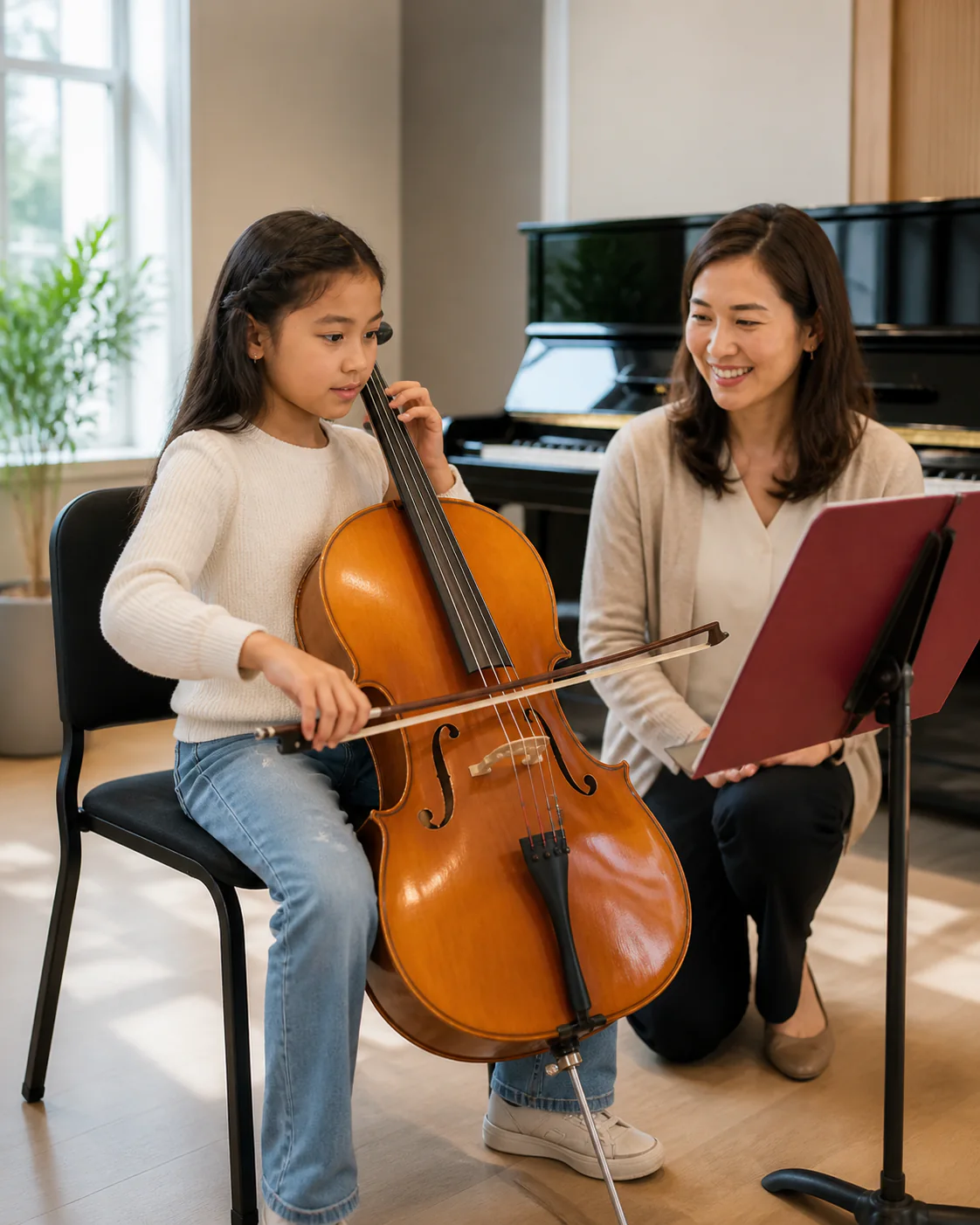
The best age to start cello lessons is between 6 and 8 for most children, slightly later than violin because cello requires more physical reach and a larger fractional instrument, though some children with strong music backgrounds are ready by age 5.
Most-cited age range
Ages 6 to 8
Cello also welcomes late-starting teens and adults — it is one of the most popular instruments for adult beginners because the seated posture is comfortable and the tone is forgiving.
Not sure they are ready?
Tell us the student's age, focus level, and any prior experience. We can help decide whether a trial lesson makes sense now.
Cello waits a year or two longer than violin for two practical reasons. The instrument is larger, so even the smallest fractional cello (1/10) doesn't fit a typical 4-year-old. And the seated posture, bow grip, and left-hand stretch all require slightly more body coordination than violin does.
By age 6, most children can hold a 1/4 or 1/2 cello comfortably, sit with stable posture for 20 minutes, and follow physical instructions about bow placement and finger spacing. By age 7 or 8, even tentative beginners pick the instrument up quickly.
Cello is one of the most rewarding instruments for early-elementary students because the bass-clef voice fits naturally with school orchestra programs — most elementary and middle school orchestras have plenty of room for cellists, so committed students often get ensemble opportunities within the first 2 to 3 years.
For children under 6 who are excited about strings, the cleanest path is violin starting at 4 or 5, then optionally switching to cello around age 8 or 9. Violin technique transfers extremely well, and most young cellists at Opus 1 either started on violin first or did Music for Young Children for one to two years.
Music for Young Children at Opus 1 starts at age 3 and is the right answer for children who love music but aren't ready for the physical demands of cello. The group format builds pitch recognition, rhythm vocabulary, and the early reading skills that make private cello lessons successful when the child is ready.
Cello may be the single best string instrument for adult beginners. The seated posture is comfortable for long practice sessions, the instrument's natural range matches the human voice, and the bow technique is more forgiving than violin's at the early stages.
Opus 1 regularly enrolls adult cello students — including returning learners who played in school orchestra decades ago and want to pick it back up. Tuition tiers and trial lessons work the same as any other instrument.
“Cello is harder than violin.”
After the first 6 months, the two instruments are at similar difficulty levels. Cello is slightly easier in the first 6 months because the seated posture and bow weight are more natural, and slightly harder long-term because the fingering distances are larger.
“Small kids can't play cello.”
Fractional cellos go down to 1/10 size and fit a 5- or 6-year-old well. The challenge isn't size; it's reach and stamina. Most 6-year-olds can manage. Most 4-year-olds cannot.
“There's no path to perform on cello in the Bay Area.”
California Youth Symphony, El Camino Youth Symphony, and most Bay Area school orchestras consistently audition cellists. Opus 1 students have placed in honor orchestras and continued cello at the conservatory level.
Frequently asked
Five can work if the child has unusually long arms and a focused temperament — but most teachers prefer to wait until 6 or 7. A trial lesson is the best way to see whether the student can handle a 1/10 or 1/8 cello comfortably.
Most 6-year-olds start on a 1/4 cello. Smaller or younger students use 1/8 or 1/10; larger 7- and 8-year-olds often go directly to 1/2. Your teacher measures the student at the trial lesson and recommends a local rental shop.
Yes — and many do well with both. The two instruments share enough technique (left-hand finger placement, bow grip basics) that progress is faster than starting cello cold. Adding a second instrument typically means a second weekly lesson, billed as a separate monthly membership.
At Opus 1 Music Studio, cello lessons follow the same monthly membership pricing as every other instrument. Trial lessons start at $25 for 30 minutes, and monthly membership for one weekly private lesson ranges from $265 to $595 depending on lesson length and teacher level.
Probably not for the full 30 minutes, and that's expected. It is completely normal for young beginners to move around the room a bit during parts of a lesson — that is not a sign the child isn't ready for music lessons. Opus 1 teachers build short movement breaks, posture games, and changes of activity into early lessons so the student stays engaged. Steady seated focus develops over months of weekly lessons, not before they start.
For most 5- to 7-year-olds, 30 minutes is the right starting lesson length. Young children's attention typically does not support a longer block, so a longer lesson does not yield proportionally more learning. Students who are already 8 or older should start with a 45-minute lesson by default, unless the studio recommends otherwise after a trial lesson. Very serious or advanced young students sometimes do benefit from 45-minute lessons earlier, and your Opus 1 teacher will recommend a step up when the student is ready. For students age 8 and up, a 45-minute lesson is the minimum recommended length and the standard for meaningful weekly progress — it gives the teacher time to review the past week's practice, discuss long-term goals (upcoming recitals, exams, competitions, audition prep), warm up, run technique exercises, work on one or two pieces, and assign specific homework for the following week. A 30-minute lesson at age 8+ tends to compress into rushed technique with little room for goal-setting or feedback.
Yes. Advanced Opus 1 students preparing for a recital, ABRSM or Certificate of Merit exam, audition, or competition have three options for additional lesson time. First, make-up credits earned from properly-cancelled lessons can be used to schedule additional lessons in the weeks leading up to a performance. Second, students preparing for major events can have a second weekly lesson evaluated and added as a separate monthly membership. Third, individual one-off extra lessons can be purchased through the studio. Talk with your teacher about which option fits the student's goals and schedule.
Ready to start cello?