Most-cited age range
Ages 5 to 7
Children younger than 5 thrive in Music for Young Children group classes, and teens and adults can start piano successfully at any age.
Piano readiness guide
The best age to start piano lessons is between 5 and 7 for most children, with some students ready as early as 4 and others benefiting from waiting until 6 or 7 — readiness depends more on attention span, letter and number recognition, and finger independence than on calendar age.
Most-cited age range
Ages 5 to 7
Children younger than 5 thrive in Music for Young Children group classes, and teens and adults can start piano successfully at any age.
Not sure they are ready?
Tell us the student's age, focus level, and any prior experience. We can help decide whether a trial lesson makes sense now.
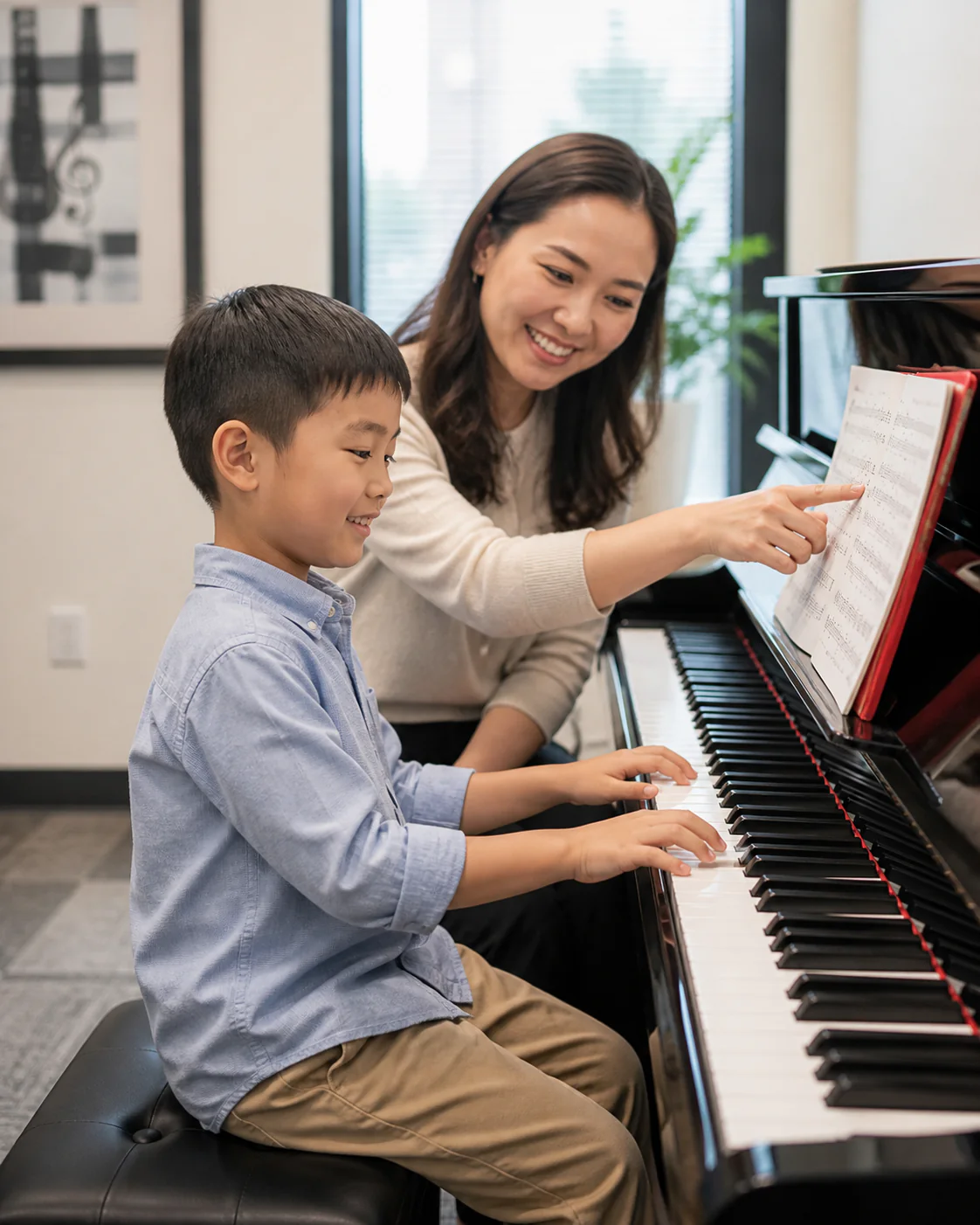
Piano is the most forgiving instrument to begin with because it makes no physical demands a typical 5-year-old cannot meet. A 5-year-old can sit on a bench, press a key, and produce a beautiful tone immediately — there is no embouchure, no bow hold, no intonation problem to fix before the music starts. That low barrier to a satisfying first sound is why piano is the instrument most often recommended as a first instrument.
What matters more than age is whether the child can do four things: sit and focus for about 20 minutes, recognize the letters A through G, count to ten, and separate the movements of the left and right hands voluntarily. These are typical milestones for ages 5 through 7. Some bright, focused 4-year-olds are ready; some 6-year-olds aren't quite there yet. A short trial lesson is the cleanest way to find out.
Once a student has those four skills, piano builds beautifully from there. Two-clef reading (treble and bass) is a much faster path to musical literacy than a single-line instrument. Independent hands train the brain in ways research consistently links to gains in math, reading, and executive function.
Children between 3 and 5 do best in a music-readiness program rather than private piano lessons. At Opus 1, that program is Music for Young Children — small group classes where children build the pitch recognition, rhythm vocabulary, ear training, and early reading skills that make private piano lessons successful when they are ready to start.
Starting MYC at age 3 or 4 and transitioning to private piano at age 5 or 6 is the single most common path among Opus 1's long-term piano students. Parents who try to push private lessons earlier than age 5 often find the lessons stall — the child enjoys playing, but the gap between what the teacher is asking and what the child can produce widens, and motivation drops.
Piano is one of the best instruments to start in middle school, high school, or adulthood. The brain's musical-learning ability does not close at any age — what matters at age 14 or 40 is the same thing that matters at age 6: consistent weekly practice and a teacher who can match the student's goals.
Adult beginners frequently progress faster than children in the first year because they bring focus, motivation, and the ability to practice deliberately rather than just playing through pieces. Opus 1 enrolls adult piano students at every level, including absolute beginners. Tuition tiers and trial lessons work the same way regardless of age.
“If you don't start before age 7, it's too late.”
There is no neurological cliff at age 7. Some skills — perfect pitch, native-language accent — have early windows, but practical piano proficiency is not one of them. Students who start at 10, 15, or 40 routinely pass ABRSM exams, perform recitals, and earn music degrees.
“My child has to read fluently before starting piano.”
Letter recognition (A–G) is enough. Music notation is its own reading system that develops alongside spoken-language reading. Many Opus 1 piano students start during kindergarten while still learning to read English.
“We need a grand piano at home.”
A 61-key digital keyboard with weighted touch is enough to begin. A full-size acoustic upright or 88-key digital piano becomes worthwhile within the first 1–2 years. Your teacher can recommend a model that fits your space and budget after the trial.
Frequently asked
For most 4-year-olds, yes — private piano lessons before age 5 usually move slower than the child's attention span supports. Music for Young Children at Opus 1 is designed for ages 3 through 6 and gives 4-year-olds a structured way to build music skills in a group format. Most students transition to private piano lessons between age 5 and 6.
No. Ten is an excellent age to start piano — students at this age can read music notation quickly, understand technique instructions, and practice deliberately. Many Opus 1 students who start at 9 or 10 reach ABRSM Grade 5 within four years of weekly lessons.
The best starting age is the same anywhere — between 5 and 7 for typical readiness, earlier with Music for Young Children, or any age for teens and adults. Opus 1 Music Studio runs piano lessons at our Palo Alto campus on El Camino Real and our two Mountain View campuses (Grant Road and Moffett), with both daytime and after-school slots available.
Not strictly — but piano builds a stronger early foundation than most single-line instruments because it teaches two-clef reading from day one. Many violin, cello, and voice teachers recommend that students study piano alongside their main instrument for theory and ear training, which is why some Opus 1 students enroll in two weekly lessons.
It takes about 6 to 12 months of consistent weekly lessons and daily 15–20 minute practice to play simple pieces fluently. ABRSM Grade 5 typically takes 4 to 7 years from a fresh start, and most students who pass the Grade 8 exam have been playing for 8 to 12 years. Adult beginners often compress the early years substantially.
Probably not for the full 30 minutes, and that's expected. It is completely normal for young beginners to move around the room a bit during parts of a lesson — that is not a sign the child isn't ready for music lessons. Opus 1 teachers build short movement breaks, posture games, and changes of activity into early lessons so the student stays engaged. Steady seated focus develops over months of weekly lessons, not before they start.
For most 5- to 7-year-olds, 30 minutes is the right starting lesson length. Young children's attention typically does not support a longer block, so a longer lesson does not yield proportionally more learning. Students who are already 8 or older should start with a 45-minute lesson by default, unless the studio recommends otherwise after a trial lesson. Very serious or advanced young students sometimes do benefit from 45-minute lessons earlier, and your Opus 1 teacher will recommend a step up when the student is ready. For students age 8 and up, a 45-minute lesson is the minimum recommended length and the standard for meaningful weekly progress — it gives the teacher time to review the past week's practice, discuss long-term goals (upcoming recitals, exams, competitions, audition prep), warm up, run technique exercises, work on one or two pieces, and assign specific homework for the following week. A 30-minute lesson at age 8+ tends to compress into rushed technique with little room for goal-setting or feedback.
Yes. Advanced Opus 1 students preparing for a recital, ABRSM or Certificate of Merit exam, audition, or competition have three options for additional lesson time. First, make-up credits earned from properly-cancelled lessons can be used to schedule additional lessons in the weeks leading up to a performance. Second, students preparing for major events can have a second weekly lesson evaluated and added as a separate monthly membership. Third, individual one-off extra lessons can be purchased through the studio. Talk with your teacher about which option fits the student's goals and schedule.
Ready to start piano?