Most-cited age range
Ages 4 to 7
Violin uses fractional sizes from 1/16 through full size, so a properly-fitted instrument exists for almost every body type — including 3-year-old Suzuki beginners and adult learners.

Violin readiness guide
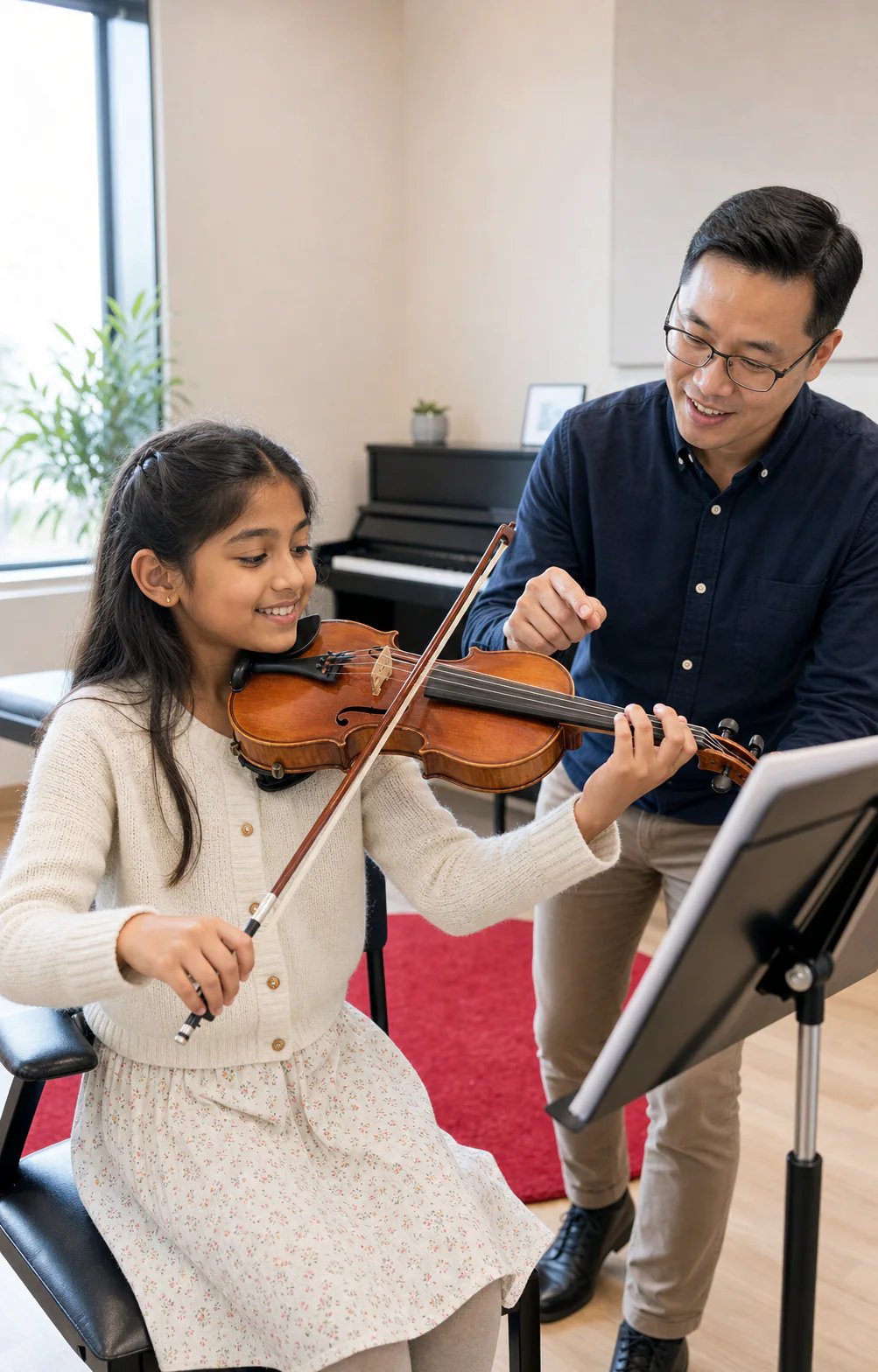
The best age to start violin lessons is between 4 and 7 for most children, with the Suzuki tradition beginning as early as 3 and many teachers preferring students wait until at least 5 — readiness depends on attention span, ability to follow physical instruction, and access to a properly-sized fractional violin.
Most-cited age range
Ages 4 to 7
Violin uses fractional sizes from 1/16 through full size, so a properly-fitted instrument exists for almost every body type — including 3-year-old Suzuki beginners and adult learners.
Not sure they are ready?
Tell us the student's age, focus level, and any prior experience. We can help decide whether a trial lesson makes sense now.
Violin is one of the rare instruments where children genuinely benefit from starting early. Two physical skills — accurate intonation by ear, and the small-motor coordination of left-hand fingering — develop best when introduced before the brain stops treating fine pitch as a primary signal. The Suzuki tradition, which begins as early as age 3, is built around exactly this observation.
That said, age 3 is not the right age for most children. A 3-year-old Suzuki beginner needs a parent who attends every lesson, sits with the child during daily practice, and patiently models posture and bow hold for months before the child plays a note independently. Families with that capacity see remarkable results. Families without it usually get better results by waiting until age 5 or 6 and starting with a more traditional approach.
By age 7, most children can hold a 1/4 or 1/2 violin comfortably, read simple notation, and follow physical instruction about posture and bow grip. By age 10, the violin becomes much harder to start cold because adult-shaped posture habits are already forming.
For 3- and 4-year-olds, two paths work well. The first is Suzuki violin with a parent who can fully participate — Opus 1 has teachers experienced with the Suzuki preparatory phase, where the child observes lessons, learns posture games, and listens to recordings before bowing a string. The second is Music for Young Children, our group program that builds rhythm, pitch, and reading foundations without committing the family to the Suzuki practice routine.
Some families do both — MYC at age 3 or 4 and private violin lessons starting at age 5 or 6. That sequence costs more but produces strong technique without the intensive early parental load.
Yes — but with eyes open. Adult violin beginners face two real challenges that don't apply to piano. First, intonation: there are no frets, so the ear has to do work that takes time to develop. Second, posture: holding the instrument between the jaw and shoulder is awkward at first and requires a teacher who can spot small misalignments before they become habit.
With those two understood, plenty of Opus 1 students start violin in middle school, high school, or adulthood and reach genuine playing competence. Most adult beginners take an extra year compared to a child starting at 6 to reach the same musical milestone — not because their brains can't learn, but because the physical setup needs more deliberate attention.
“If you don't start violin by age 5, you'll never get good.”
Late starters can reach professional-track levels with deliberate practice. The Suzuki advantage is real for ear training and posture habits, but it does not make late starts impossible — it just changes the path.
“You need an expensive violin to start.”
A properly-sized rental is the right starting point. Children grow through fractional sizes every 1–2 years; buying high-end instruments early is wasted money. A $25–$45/month rental from a local violin shop is the standard.
“Violin is too hard for young children.”
Violin is harder than piano in the first 6 months because the instrument doesn't make a beautiful sound on its own — the student produces every aspect of the tone. After about a year, the difficulty curves are similar.
Frequently asked
Three is the youngest age the Suzuki method recommends, and it works only when a parent attends lessons and practices daily with the child. If that's not realistic, Music for Young Children at Opus 1 starts at age 3 and builds the same pitch and rhythm foundations without the daily practice load.
Most 5-year-olds use a 1/8 or 1/4 violin, depending on arm length. Your teacher measures the student at the trial lesson and recommends a size. Renting is strongly recommended since children typically grow into the next size every 12 to 18 months until they reach full size around age 11 or 12.
Yes — Opus 1 enrolls adult violin students at every level, from absolute beginners through returning adult learners. Adult lessons typically focus on healthy posture, intonation training, and repertoire the student wants to play. Trial pricing and tuition tiers are the same for adults as for children.
Most violin students play their first recognizable piece (Twinkle, Twinkle or similar) within 4 to 8 months of weekly lessons. The first 6 months focus heavily on posture, bow hold, and pulling a clean tone before melodies are added. That foundation is what makes long-term progress possible.
Probably not for the full 30 minutes, and that's expected. It is completely normal for young beginners to move around the room a bit during parts of a lesson — that is not a sign the child isn't ready for music lessons. Opus 1 teachers build short movement breaks, posture games, and changes of activity into early lessons so the student stays engaged. Steady seated focus develops over months of weekly lessons, not before they start.
For most 5- to 7-year-olds, 30 minutes is the right starting lesson length. Young children's attention typically does not support a longer block, so a longer lesson does not yield proportionally more learning. Students who are already 8 or older should start with a 45-minute lesson by default, unless the studio recommends otherwise after a trial lesson. Very serious or advanced young students sometimes do benefit from 45-minute lessons earlier, and your Opus 1 teacher will recommend a step up when the student is ready. For students age 8 and up, a 45-minute lesson is the minimum recommended length and the standard for meaningful weekly progress — it gives the teacher time to review the past week's practice, discuss long-term goals (upcoming recitals, exams, competitions, audition prep), warm up, run technique exercises, work on one or two pieces, and assign specific homework for the following week. A 30-minute lesson at age 8+ tends to compress into rushed technique with little room for goal-setting or feedback.
Yes. Advanced Opus 1 students preparing for a recital, ABRSM or Certificate of Merit exam, audition, or competition have three options for additional lesson time. First, make-up credits earned from properly-cancelled lessons can be used to schedule additional lessons in the weeks leading up to a performance. Second, students preparing for major events can have a second weekly lesson evaluated and added as a separate monthly membership. Third, individual one-off extra lessons can be purchased through the studio. Talk with your teacher about which option fits the student's goals and schedule.
Ready to start violin?