Most-cited age range
Ages 6 to 9
Younger children often start on ukulele (4 nylon strings, smaller body) and switch to guitar around age 7 or 8. Teens and adults can start guitar at any age.

Guitar readiness guide
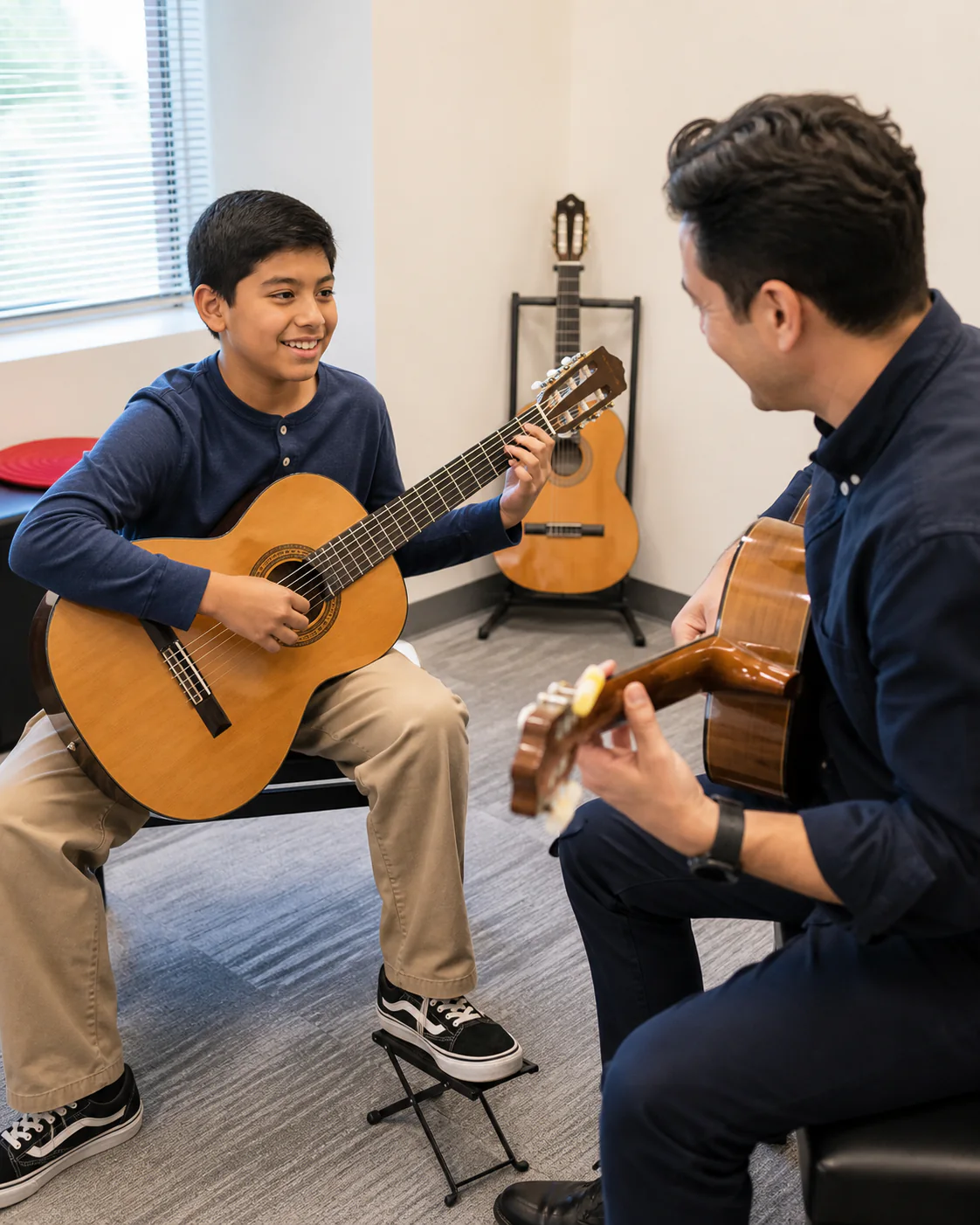
The best age to start guitar lessons is between 6 and 9 for most children — guitar needs hand size and finger strength to hold down strings cleanly, which is why teachers often suggest waiting until a child's hands have grown enough to wrap around a 1/2 or 3/4-size guitar neck.
Most-cited age range
Ages 6 to 9
Younger children often start on ukulele (4 nylon strings, smaller body) and switch to guitar around age 7 or 8. Teens and adults can start guitar at any age.
Not sure they are ready?
Tell us the student's age, focus level, and any prior experience. We can help decide whether a trial lesson makes sense now.
Guitar is more physically demanding for young children than people expect. Holding down a steel-string chord requires real finger strength, and stretching across 3 to 4 frets is uncomfortable for small hands. A determined 5-year-old can start, but the first 6 months are often a struggle that drains motivation.
By age 7 or 8, most children can hold down chord shapes cleanly on a 3/4-size acoustic, follow finger-placement instruction, and practice for 15 to 20 minutes without their fingertips giving out. By age 10, full-size classical or steel-string guitars become workable.
Guitar's biggest motivation advantage is repertoire — students hear and want to play modern songs, which sustains practice in a way that very few instruments match. The trade-off is that the first six months are technically harder than piano or ukulele.
For children 4 through 7, ukulele is often the better starting instrument. The strings are nylon (gentle on small fingers), there are only 4 of them, and the body is small enough to hold comfortably. Many of the chord shapes transfer directly to guitar — a child who plays C, F, and G on a ukulele has already learned 3 of the 8 chords needed for most pop songs on guitar.
At Opus 1, students often start ukulele around age 5 or 6 and transition to guitar at 7 or 8 when their hand size catches up. Music for Young Children is the other earlier option — a group program from age 3 that builds rhythm, pitch, and music reading.
Guitar is the classic adult-beginner instrument and for good reason. Teens and adults bring the focus, hand strength, and motivation that young beginners are still building. Most adults can play recognizable songs within 2 to 3 months of weekly lessons, and the path from there scales with practice consistency rather than age.
Opus 1 teaches acoustic, classical, and electric guitar across rock, pop, blues, jazz, classical, folk, and songwriting. Adult students can choose a style first and let the teacher tailor lessons around it.
“If you don't start guitar young, you'll never be good.”
Most professional rock and singer-songwriter guitarists started between 10 and 16. There is no early-childhood window for guitar in the way there is for violin pitch development. Late starters who practice consistently routinely match or exceed early starters.
“Electric guitar is for advanced players only.”
Electric guitar is often easier for beginners — lighter strings, shorter fret reach, less force to produce sound. A child motivated by rock music will often progress faster on electric than on a steel-string acoustic.
“You need an expensive guitar to start.”
A $100–$200 student acoustic or classical guitar is sufficient for the first 1–2 years. Spending more on a beginner instrument doesn't speed progress; it just makes the case for upgrading later.
Frequently asked
For most 5-year-olds, yes — chord shapes and string pressure are usually too physically demanding. A child this age who wants to play a stringed instrument is almost always better off starting on ukulele or doing Music for Young Children, then switching to guitar at 7 or 8.
Most 8-year-olds start on a 1/2 or 3/4-size acoustic or classical guitar. Children with larger hands sometimes go straight to a 3/4 or even a small-bodied full-size. Your teacher measures fit at the trial lesson and recommends a model.
Classical (nylon-string) is the most forgiving on small hands and the most common starting point for children. Steel-string acoustic suits older beginners interested in pop and folk. Electric works well for kids motivated by rock and metal — the lighter strings actually help small fingers. Any of the three is a valid starting point.
Most students play simple songs within 2 to 4 months of weekly lessons. Reasonable rhythm and lead playing develops over 1 to 3 years. Serious lead-guitar fluency and stage-ready performance takes 4 to 8 years of consistent practice — but enjoyable, social-level playing is achievable in the first year.
Probably not for the full 30 minutes, and that's expected. It is completely normal for young beginners to move around the room a bit during parts of a lesson — that is not a sign the child isn't ready for music lessons. Opus 1 teachers build short movement breaks, posture games, and changes of activity into early lessons so the student stays engaged. Steady seated focus develops over months of weekly lessons, not before they start.
For most 5- to 7-year-olds, 30 minutes is the right starting lesson length. Young children's attention typically does not support a longer block, so a longer lesson does not yield proportionally more learning. Students who are already 8 or older should start with a 45-minute lesson by default, unless the studio recommends otherwise after a trial lesson. Very serious or advanced young students sometimes do benefit from 45-minute lessons earlier, and your Opus 1 teacher will recommend a step up when the student is ready. For students age 8 and up, a 45-minute lesson is the minimum recommended length and the standard for meaningful weekly progress — it gives the teacher time to review the past week's practice, discuss long-term goals (upcoming recitals, exams, competitions, audition prep), warm up, run technique exercises, work on one or two pieces, and assign specific homework for the following week. A 30-minute lesson at age 8+ tends to compress into rushed technique with little room for goal-setting or feedback.
Yes. Advanced Opus 1 students preparing for a recital, ABRSM or Certificate of Merit exam, audition, or competition have three options for additional lesson time. First, make-up credits earned from properly-cancelled lessons can be used to schedule additional lessons in the weeks leading up to a performance. Second, students preparing for major events can have a second weekly lesson evaluated and added as a separate monthly membership. Third, individual one-off extra lessons can be purchased through the studio. Talk with your teacher about which option fits the student's goals and schedule.
Ready to start guitar?